


Why Behavior-Based Controls Outperform Policies and Allowlists
by Source Defense
Security history is full of examples where static controls eventually gave way to behavioral ones. Antivirus signatures became EDR. Firewall rules were augmented with anomaly detection. eSkimming security is now, and needs to, follow the same trajectory.
Policies and allowlists were never meant to defend against dynamic, adaptive threats – and modern eSkimming attacks are exactly that. Take the research conducted for the 2025 Source Defense eSkimming Threat Report as ample evidence.
The limits of traditional approaches to eSkimming security
Allowlists assume that trusted entities remain trustworthy. Policies assume that approved behavior doesn’t change. In the world of eSkimming attacks, both assumptions are routinely violated.
Third-party scripts:
- Update automatically
- Change behavior without notice
- Load additional dependencies dynamically
- Operate differently based on context
Once a script is allowed, it often retains broad access to page content and user inputs. If that script is compromised – or simply over-collects and shares privacy protected data with third parties – the damage is done.
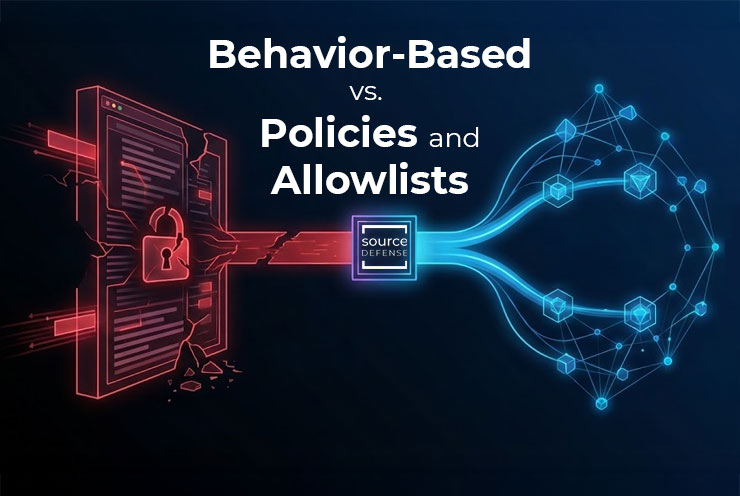
Behavior-based controls flip the model
Instead of trusting scripts by default, behavior-based controls enforce least privilege at runtime. Scripts are evaluated based on what they attempt to do, not what they claim to be.
This allows organizations to prevent both malicious and accidental data exposure by enforcing rules such as:
- Which scripts can read sensitive fields
- Which scripts can transmit data externally
- Which actions are permitted on specific pages
Because enforcement happens in real time, new or unknown attacks can be stopped without prior signatures.
Why site-wide protection is critical to eSkimming security
Behavior-based controls scale naturally across the entire site. They don’t rely on identifying “high-risk pages” in advance. Whether a script runs on a marketing page, login flow, or checkout, its behavior is evaluated consistently.
This directly addresses the upstream attack patterns Source Defense and its partners have consistently observed, where attackers avoid payment pages entirely and focus on upstream compromise as the foothold for their illicit activity.
Operational benefits matter too
From an operational standpoint, behavioral controls reduce burden. Security teams don’t need to constantly update allowlists or chase script changes. Policies are applied centrally and enforced automatically, providing clear evidence for audits and investigations.
This is particularly important as compliance expectations rise and security teams are asked to do more with fewer resources.
The direction of the industry is clear
Static controls are not disappearing, but they are no longer sufficient. As eSkimming attacks continue to evolve, organizations that rely solely on policies and allowlists will remain one step behind.
Behavior-based controls don’t just detect problems faster – they prevent them from happening in the first place.
Learn more about Source Defense
For true security against eSkimming – which should be a top priority for all payment security professionals given the ample evidence of attack proliferation, a behavioral based approach is the only way to address this issue.
To see what Source Defense can see that your CSP and SRI based solutions can’t, book a 30 minute demo today!
 Previous