


Why “Do-It-Yourself” eSkimming Security Falls Short and What to Do Instead
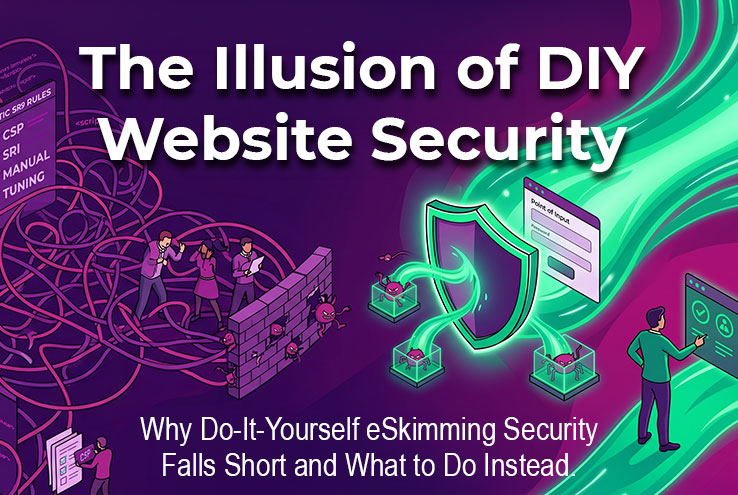
by Source Defense
For many security and compliance teams, PCI DSS 4.0.1 has triggered a familiar conversation when it comes to the new eSkimming controls requirements: should we build this ourselves?
On paper, a do-it-yourself approach to eSkimming/digital skimming security (aka client-side security) can seem appealing. Teams already manage web infrastructure. CSP (Content Security Policy) and SRI (Subresource Integrity), which are referenced in the DSS are well-known controls. Internal development resources can be made available.
In practice, that approach quickly becomes one of the most complex, resource-intensive, and risk-prone initiatives in the modern security stack.
The Illusion of Control in DIY Approaches
Most DIY strategies for eSkimming security rely heavily on CSP and SRI. These controls operate on static rules – defining where scripts can load from or validating file integrity at a single point in time. These controls shouldn’t be referenced in the DSS any longer, we believe this wholeheartedly and a chorus of other voices from the industry support that position. Why?
Modern websites are dynamic ecosystems. Scripts change constantly. Third-party services introduce fourth- and fifth-party dependencies without warning. Trusted services can be compromised. Attackers increasingly operate inside allowed domains and legitimate infrastructure.
Static controls cannot keep up with dynamic threats.
CSP requires continuous tuning to avoid breaking site functionality. SRI struggles with scripts that change frequently. Neither provides visibility into what scripts actually do at runtime, whether they access payment data, capture keystrokes, or exfiltrate sensitive information. The result is a dangerous gap: organizations believe they are protected, while attackers operate undetected within trusted pathways.
The Hidden Cost of Building It Yourself
The technical challenge is only part of the story. The operational burden is where DIY approaches truly break down. Building a client-side security solution is not a one-time project. It is an ongoing program that requires:
- Continuous script inventory and classification
- Manual authorization and justification workflows
- Constant policy tuning as scripts change
- Monitoring, alert triage, and response processes
- Coordination across security, development, and marketing teams
This quickly becomes a long-tail effort measured in months or years, not weeks. Even after initial deployment, the work never stops. Every new script, every site update, every marketing tool introduces new risk that must be evaluated and managed.
Security teams become script auditors. Developers become policy managers. Marketing teams face friction when tools break or are blocked. All of this pulls resources away from core business priorities.
A Different Approach: Prevention at the Point of Input
Effective eSkimming security requires a fundamentally different model – one that focuses on controlling behavior in real time. This is where Source Defense has spent the past decade. As the pioneer in client-side security, Source Defense was built specifically to address the gap that DIY approaches struggle to close: understanding and controlling the behavior of scripts inside the browser. Instead of relying on static rules, Source Defense applies a behavior-based model that:
- Monitors how scripts interact with sensitive data in real time
- Prevents unauthorized access before data is exposed
- Isolates scripts through patented sandboxing technology
- Blocks both malicious activity and inadvertent data leakage
This approach aligns with how modern attacks actually operate. It does not assume scripts are safe because they are trusted. It applies a zero-trust model. It verifies what they do – every time they run.
Simplicity at Scale
One of the most overlooked challenges in DIY approaches is ongoing management. Source Defense was designed to remove that burden. With a compliance-ready dashboard aligned to PCI DSS 4.0.1 requirements 6.4.3 and 11.6.1, organizations gain:
- Automated script inventory and authorization
- Continuous monitoring and policy enforcement
- Clear, audit-ready reporting
Most clients spend less than an hour per month managing the platform. That is the difference between building a program and deploying a solution.
Trusted Expertise, Proven at Scale
Source Defense brings more than technology. It brings experience.
- A decade of real-world client-side threat intelligence
- Deep understanding of script behavior across thousands of environments
- Active participation in shaping PCI DSS standards as a Principal Participating Organization and PCI Board of Advisors member
- Recognition as a global partner with Mastercard in combating digital skimming
This is built on years of observing how attackers operate and how to stop them.
Focus on What Matters
Security teams today are asked to do more with less. Every hour spent managing scripts, tuning policies, or chasing alerts is an hour not spent on strategic risk reduction. DIY approaches promise control, but deliver complexity. Source Defense delivers control through simplicity.
A prevention-first model. Minimal operational overhead. Proven alignment with compliance requirements. And a platform purpose-built to secure the modern digital supply chain. When it comes to protecting customer data at the point of input, the question is not whether you can build something. It is whether you should. For most organizations, the answer is clear: this is not a problem to solve alone. It is one to solve correctly.
 Previous