by Source Defense
Headless commerce is rapidly becoming the default architecture for modern digital businesses. By decoupling the frontend experience from backend commerce platforms, organizations gain flexibility, performance, and the ability to deliver consistent experiences across web, mobile, and emerging channels.
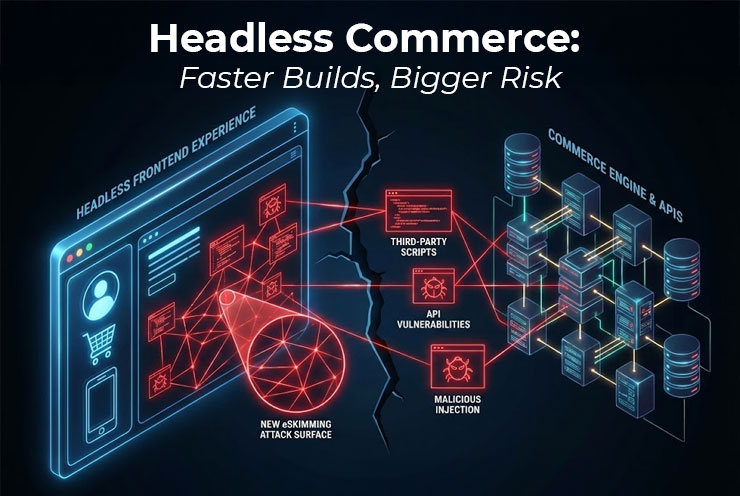
But that architectural shift comes with a security tradeoff that many teams are only beginning to understand: it dramatically expands the eSkimming (client-side) attack surface.
Multiple industry analysts, including Gartner and Forrester, have noted that headless and composable architectures increase reliance on third-party JavaScript and APIs. In practice, that means more scripts, more vendors, and more runtime complexity executing directly in the browser – precisely where traditional security tools have the least visibility.
Why headless changes the risk equation
In a traditional monolithic ecommerce stack, much of the logic lived server-side. In headless models, logic moves outward – to the browser and to third-party services. Frontend frameworks, personalization engines, analytics platforms, payment widgets, experimentation tools, and consent managers all execute client-side.
SecurityMetrics, Sansec, Source Defense and other forensic firms have consistently reported that modern eSkimming attacks exploit this client-side complexity rather than backend vulnerabilities. In SecurityMetrics’ analysis of thousands of skimming incidents, attackers overwhelmingly leveraged JavaScript injection and manipulation rather than direct payment system compromise.
Headless architectures accelerate this trend by design.
More APIs, more scripts, more trust
Composable commerce depends on APIs and modular services. Each service introduces its own JavaScript libraries, SDKs, and dependencies. Over time, organizations end up with dozens – or hundreds – of third- and fourth-party scripts running across pages.
Industry research repeatedly shows that attackers follow trust relationships. Verizon’s Payment Security reporting and independent investigations from firms like RiskIQ (now part of Microsoft) and Sucuri have documented eSkimming campaigns that specifically target widely used frontend frameworks and third-party services.
In a headless environment, compromising one trusted frontend dependency can provide access across the entire customer journey.
Why traditional defenses struggle even more in headless environments
Controls like CSP, SRI, WAFs, and backend monitoring were never designed to govern highly dynamic frontend logic assembled at runtime. Headless deployments frequently require permissive CSPs to support rapid iteration and third-party integrations, weakening their effectiveness even further.
Meanwhile, many organizations continue to scope security narrowly around checkout or payment components, assuming that upstream frontend layers are “presentation only.” That assumption no longer holds when presentation layers actively handle identity, personalization, and user input.
What the data shows attackers actually do
Across public incident disclosures and forensic write-ups, several consistent patterns emerge:
- Attackers inject malicious logic into trusted frontend components
- Data is harvested upstream from login, search, or account flows
- Exfiltration often uses legitimate APIs or cloud services
- Checkout pages may never be directly compromised
These patterns align closely with what Source Defense and its partners have observed in large-scale browser telemetry and client investigations.
What this means for organizations adopting headless commerce
Headless commerce isn’t inherently insecure – but it is inherently client-side dependent. That makes runtime visibility and behavioral enforcement essential.
Organizations embracing headless architectures must assume:
- More scripts will run in the browser
- Those scripts will change frequently
- Trust boundaries will be fluid
- Attackers will target frontend supply chains
Without site-wide, behavior-based controls, headless commerce environments amplify the very risks attackers are exploiting today.
To learn more about the pioneering, behavioral-based approach to client-side / eSkimming security which has made Source Defense the most trusted name in the sector – request a demo today!